

Last Updated: November 23, 2026
Quick Summary
What makes a shirt high quality comes down to four measurable things: fabric weight, fiber type, stitch construction, and how the collar is built. Check GSM, ring-spun versus carded cotton, stitches per inch, and whether the collar snaps back when stretched. A quality shirt should shrink less than 5% in length and less than 3% in width.
- A men's large tee at 180 GSM typically weighs around 180-200 grams.
- Multiply fabric weight in ounces by 33.9 to approximate GSM, so 4.5 oz is about 153 GSM.
- Hold the hem to a light and count stitches in a one-inch span; fewer than eight means the seam is built to fail.
- Stretch the collar gently in four directions; a quality collar snaps back within a second.
- Wash cold, inside out, and skip high dryer heat to protect shape retention and colorfastness.
Table of Contents
- Why Some Tees Last and Others Fall Apart
- Fabric Weight and T-shirt Quality GSM Explained
- High-Quality Materials for Clothing: Cotton, Blends and Fiber Quality
- Stitching, Seams and Collar Construction That Hold Up
- A T-shirt Quality Check You Can Do in 60 Seconds
- Shirt Fabric Durability: Shrinkage, Pilling and Shape Retention After Washing
- Sustainability and Supply Chain: What the Certifications Mean
- Shopping for a Shirt That Fits the Coastal Life
- Frequently Asked Questions
Why Some Tees Last and Others Fall Apart
What makes a shirt high quality comes down to four measurable things: fabric weight, fiber type, stitch construction, and how the collar is built. Get those right and a tee survives years of salt, sweat, and washing. Get them wrong and it turns into a stretched rag by August.
A shirt that fades or sags after a few beach trips is not a bargain at any price.
The difference is rarely visible on a hanger. It shows up in the details. Below, we break down exactly what to check, so you can judge a shirt in the store or online before you spend a cent.
Fabric Weight and T-shirt Quality GSM Explained
GSM stands for grams per square meter. It measures fabric density, and it is the fastest way to judge how a tee will feel and wear. But GSM alone is not a quality score, it is a starting point that only means something when you pair it with fiber type and knit structure.
What GSM Rating Actually Tells You
A higher GSM means a denser, heavier fabric. A lower GSM means a thinner, lighter one. Neither is automatically better, but the number tells you what to expect.
- Under 150 GSM: Very light. Cool and breathable, but often thin enough to go see-through. Common in fast-fashion multipacks.
- 150-180 GSM: Lightweight. Good for hot, humid weather and everyday summer wear. This is where most coastal and tropical tees land.
- 180-220 GSM: Midweight. The sweet spot for most people. Holds shape well and drapes without clinging.
The Gildan 64000 tee in the Mahi State Of Mind line is a lightweight 4.5 oz (153 g/m²) fabric, a weight well suited to hot coastal weather.
How to Verify a GSM Claim Before You Buy
Most brands do not print GSM on the hangtag, and some who do are guessing. Here is how to check without a lab:
- Weigh a known size. A men's large tee at 180 GSM typically weighs around 180-200 grams. If the brand lists fabric weight in ounces, multiply by 33.9 to approximate GSM (4.5 oz ≈ 153 GSM).
- Check the label for fabric weight in oz/yd². Many US brands still use ounces. A 5.3 oz tee is roughly 180 GSM; a 6.1 oz tee is roughly 207 GSM.
- Compare hand-feel to the number. A 150 GSM shirt should feel light and slightly translucent against a window. A 220 GSM shirt should feel substantial and hold a crease when folded.
Watch out: a brand that advertises "heavyweight" without a GSM or oz number is usually using marketing language, not a spec. Ask for the number or assume it is under 180 GSM.
Matching Fabric Weight to Your Climate
Climate should drive your choice. Coastal and tropical buyers want lighter fabric that moves air. Cold-weather buyers can go heavier without regret.
Watch out: a very light fabric with poor fiber quality pills and thins fast. Light weight only works when the fiber underneath is good. A 150 GSM ring-spun cotton tee will outlast a 180 GSM carded cotton tee in most real-world wash cycles because the longer fibers resist abrasion.
How GSM Predicts Post-Wash Performance
Fabric weight is one of the best predictors of how a tee survives repeated washing, but only when you combine it with knit type and fiber length.
- Under 150 GSM: Expect visible thinning and possible hole formation at stress points after 20-30 washes, especially in carded cotton.
- 150-180 GSM ring-spun: Holds shape and opacity through 40-50 washes in most home laundry conditions. This is the range where lightweight tees stop being disposable.
- 180-220 GSM: The most forgiving range for shrinkage and torque. Heavier fabrics resist twisting because there is more material to distribute tension.
A common pattern in post-wash testing: the shirt that feels best in the store is not always the one that survives 50 washes.
If you want to test this yourself, wash a new tee five times inside out in cold water and tumble dry low. Measure the chest width and body length before and after. A quality shirt should shrink less than 5% in length and less than 3% in width. Anything more is a sign that the fabric was not pre-shrunk or the knit is unstable.
Here is how GSM ranges translate into feel, best use, and expected wash performance.
| GSM range | Feel and best use | Post-wash expectation |
|---|---|---|
| Under 150 GSM | Very light, breathable, often see-through | Thinning and possible holes after 20-30 washes |
| 150-180 GSM | Lightweight, good for hot, humid weather | Holds shape and opacity through 40-50 washes in ring-spun |
| 180-220 GSM | Midweight sweet spot, holds shape, drapes without clinging | Most forgiving range for shrinkage and torque |
| 220+ GSM | Heavyweight, structured and durable but warmer | Durable but slower to dry, collar stiffness risk |
High-Quality Materials for Clothing: Cotton, Blends and Fiber Quality
High-quality materials for clothing start with long-staple cotton. Longer fibers spin into smoother, stronger yarn, which means less pilling and a softer hand-feel.
The fiber is the foundation. A great construction on cheap short-staple cotton still fails.
Ring-Spun vs Carded Cotton
Ring-spun cotton is spun and twisted repeatedly, which aligns the fibers and removes short ones. The result is a smoother, stronger yarn.
Carded cotton skips that extra step. It is rougher, weaker, and more likely to pill.
You can feel the difference. Ring-spun feels softer from day one. Carded feels scratchy and gets worse.
The Gildan 64000 is made with 100% ring-spun cotton, while solid colors are 100% cotton and heathers and sport grey use polyester blends for added durability.
Stitching, Seams and Collar Construction That Hold Up
Stitching is where cheap shirts quietly give up. Look for double-needle stitching at the hems and taped seams across the shoulders on any shirt you consider. But the difference between adequate and excellent construction comes down to measurable details: stitches per inch, seam type, thread tension, and collar recovery.
Stitch Density: The Number Most Shoppers Never Check
Stitch density is the number of stitches per inch (SPI) along a seam. It is the single most predictive construction metric you can check without a lab.
- Under 8 SPI: Sparse. The seam has long exposed thread spans that snag and pull apart. Common in promotional tees.
- 8-10 SPI: Adequate for lightweight knits. Most mid-tier tees land here.
- 10-12 SPI: Good. The seam has enough redundancy to survive stress without puckering.
How to check: hold the hem up to a light and count the stitches in a one-inch span. You do not need a ruler, use the width of your thumbnail as a rough inch.
Seam Types and Where They Fail
Not all seams carry stress equally. The shoulder seam carries the weight of the shirt and the pull of the sleeves. The side seam takes lateral tension. The hem takes abrasion.
- Double-needle hems: Two parallel rows of stitching resist splitting. A single-needle hem is a cost-cutting sign.
- Taped shoulder seams: Twill tape reinforces the seam that carries the most stress. Without tape, the shoulder seam stretches and eventually separates.
- Flatlock seams: Common in athletic wear. They lie flat and reduce chafing, but they are not automatically stronger than a well-executed double-needle seam.
Watch out: a shirt with taped shoulders but a single-needle hem is a mixed construction. Brands sometimes reinforce the visible seam and cut corners on the hem, which is the seam that takes the most abrasion.
Collar Construction: Ribbing, Recovery and the Curl Test
A collar that curls after two washes is the classic cheap-tee failure. The ribbed knit and proper tension prevent it, but not all ribbing is equal.
- Ribbed-knit collar: A ribbed collar holds its shape and resists curling because the rib structure has built-in elasticity.
- Collar rib width: A 1x1 rib (one knit, one purl) is standard. A 2x2 rib is thicker and more durable but less common on lightweight tees.
- Collar recovery test: Stretch the collar gently in four directions. A quality collar snaps back within a second. A cheap collar stays stretched or returns slowly.
A common pattern: collars fail not because the ribbing is wrong but because the thread tension was set too tight during attachment. The collar looks fine on the hanger and curls after the first wash because the tension was released by water and heat.
A Visual Inspection Guide for Stitching
Most guides tell you what to look for but not how to see it. Here is a store-friendly inspection sequence:
- Turn the shirt inside out. Most construction flaws are hidden on the inside.
- Check the shoulder seam. Is there twill tape? Is the seam flat or puckered?
- Count stitches per inch on the hem. Use your thumbnail as a rough inch.
- Stretch the collar in four directions. Does it recover?
- Pull the side seam gently. Does the stitching gap or hold?
- Look for loose threads at the collar join and underarm. Loose threads are a sign of poor tension control.
- Check the hem for waviness. A wavy hem means the fabric was stretched during sewing.
If a shirt fails two of these, put it back. If it fails three, the construction is not worth the fabric it is made from.
If you want to understand garment construction standards in more depth, the OEKO-TEX textile certification standards explain what certified fabrics must pass.
A T-shirt Quality Check You Can Do in 60 Seconds
Run this T-shirt quality check before you buy. It takes about a minute.
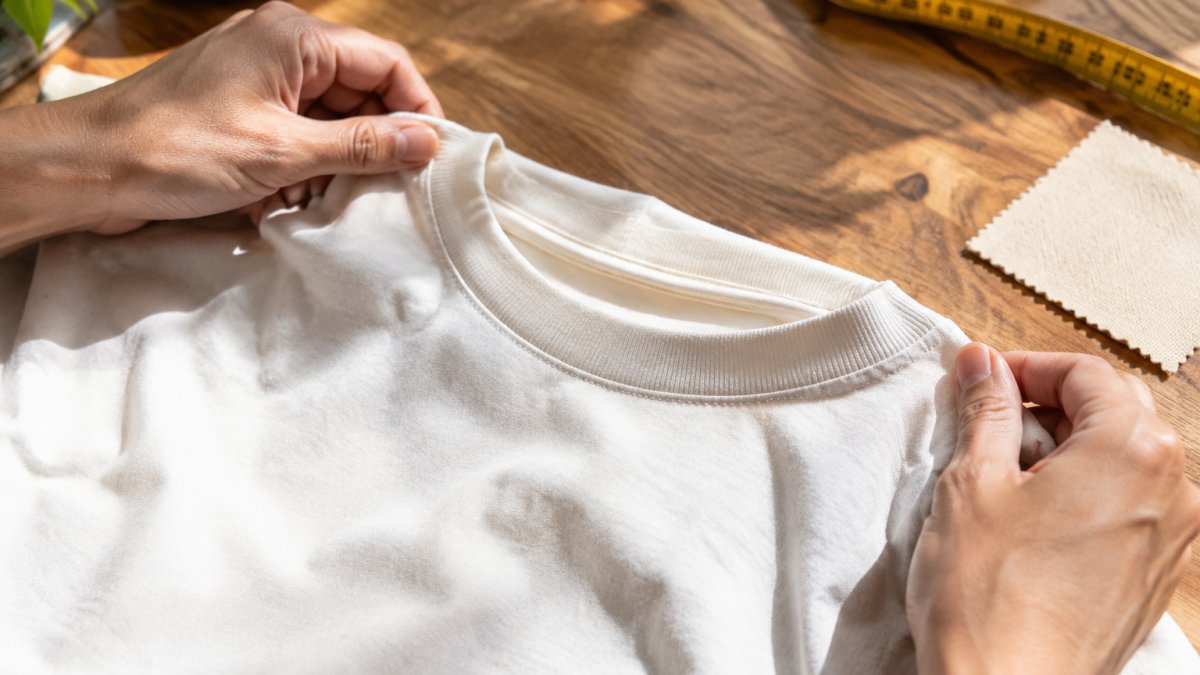
How to Spot Good Fabric and Stitching in the Store
- Hold it to the light. Can you see your hand clearly through it? Too thin.
- Stretch the collar gently. Does it snap back, or stay stretched?
- Pull the shoulder seam. Taped seams resist; bare seams gap.
If a shirt fails two of these, put it back.
Shirt Fabric Durability: Shrinkage, Pilling and Shape Retention After Washing
Shirt fabric durability is really about what survives the wash.
Pre-shrunk, ring-spun cotton shrinks less than untreated carded cotton. It also resists pilling because the short fibers were removed during spinning.
Shape retention depends on the knit and the collar. A tubular knit can twist over time.
Wash cold, inside out, and skip the high dryer heat. Heat is what kills shape retention and colorfastness.
Sustainability and Supply Chain: What the Certifications Mean
Certifications are the paper trail behind a quality claim. They tell you how the cotton was grown and how the fabric was finished.
Look for two in particular:
- OEKO-TEX STANDARD 100: Tests the finished fabric for harmful substances (OEKO-TEX® STANDARD 100).
- US Cotton Trust Protocol: Tracks ethically grown and harvested US cotton through the supply chain.
These matter for buyers who care about how their clothing is made.
Ask where the cotton comes from before you buy.
Shopping for a Shirt That Fits the Coastal Life
Now you know what to look for. The last step is finding shirts that pass the test and match how you actually live.
Here are a few to start with:
- Mahi State Of Mind T-Shirt: a fishing-forward print for the offshore crowd.
- Life Is Better On The Water T Shirt: for anyone who plans weekends around the tide.
- Born for Boat Days II T-Shirt: a boat-day staple with the same soft build.
- Dockside State Of Mind T Shirt: dockside energy in a relaxed fit.
- Island Time T Shirt: island pacing, coastal style.
The catalog tees listed here are lightweight, comfortable options for warm weather.



The hardest part of buying a quality tee is trusting the label. Check the GSM, feel the fiber, test the collar, and read the certifications.
Frequently Asked Questions
How can you tell if a shirt is high quality?
Start with the fabric weight and the stitching. A shirt in the 150-180 GSM range feels substantial without being heavy, and double-needle stitching along the hems and taped seams at the shoulders signal real construction. Check that the collar is a ribbed knit that snaps back when stretched, and look for a tear-away or printed label rather than a scratchy woven tag. Run your thumb across the print too: a high quality shirt has artwork that sits flush with the fabric instead of a thick, rubbery layer. These checks take under a minute and catch most weak tees.
Does a higher GSM mean a better-quality T-shirt?
Not automatically. GSM measures fabric density, not fiber quality or construction. A 200 GSM tee made from short, carded cotton can pill and lose shape faster than a well-made 153 GSM ring-spun shirt. Use GSM as a starting filter for how a shirt will feel and drape, then judge the rest on stitch density, seam reinforcement and collar integrity. For hot coastal weather, a lighter 150-160 GSM fabric often beats a heavy one because it breathes better while still holding its shape if the knit is tight.
What should you check when buying a T-shirt online?
Look for the fabric spec first: fiber type, weight in GSM or ounces, and whether the cotton is ring-spun. Then scan the construction notes for taped or reinforced shoulders, side seams versus tubular knit, and the collar style. Sizing charts with chest measurements beat generic small, medium and large labels, especially for a relaxed fit. Reviews that mention shrinkage and post-wash shape are worth more than star ratings alone. A brand that publishes its certifications, such as OEKO-TEX STANDARD 100, is usually more transparent about what goes into the garment.
How should you care for a T-shirt to make it last longer?
Wash cold and turn the shirt inside out to protect the print, then skip the dryer or use low heat. High heat is what breaks down cotton fibers and causes shrinkage and twisted side seams. Use a mild detergent and avoid fabric softener, which coats the fibers and reduces breathability. Hang or lay flat to dry, and fold rather than hang tees on wire hangers, which stretch the neckline over time. Following these steps protects shirt fabric durability and keeps the collar from curling, especially in salt air and humidity.
